Living Hinge As a Wearable
A living hinge that can be worn as a bracelet or watch strap.
A living hinge is a pattern of cuts that lets a stiff sheet bend. My design can be worn on the wrist as a bracelet or a watch strap. The watch face in the photos is a mockup.
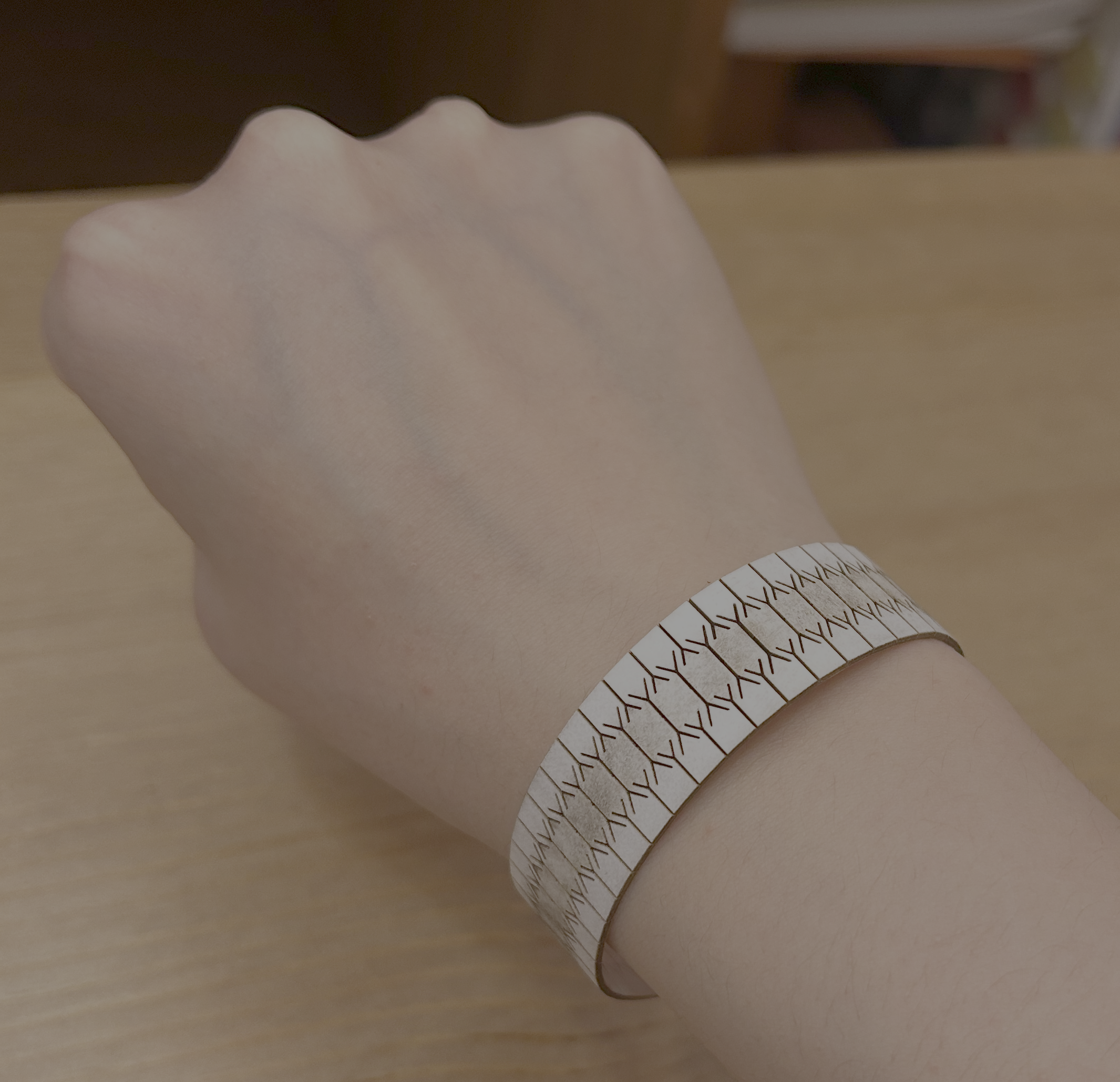
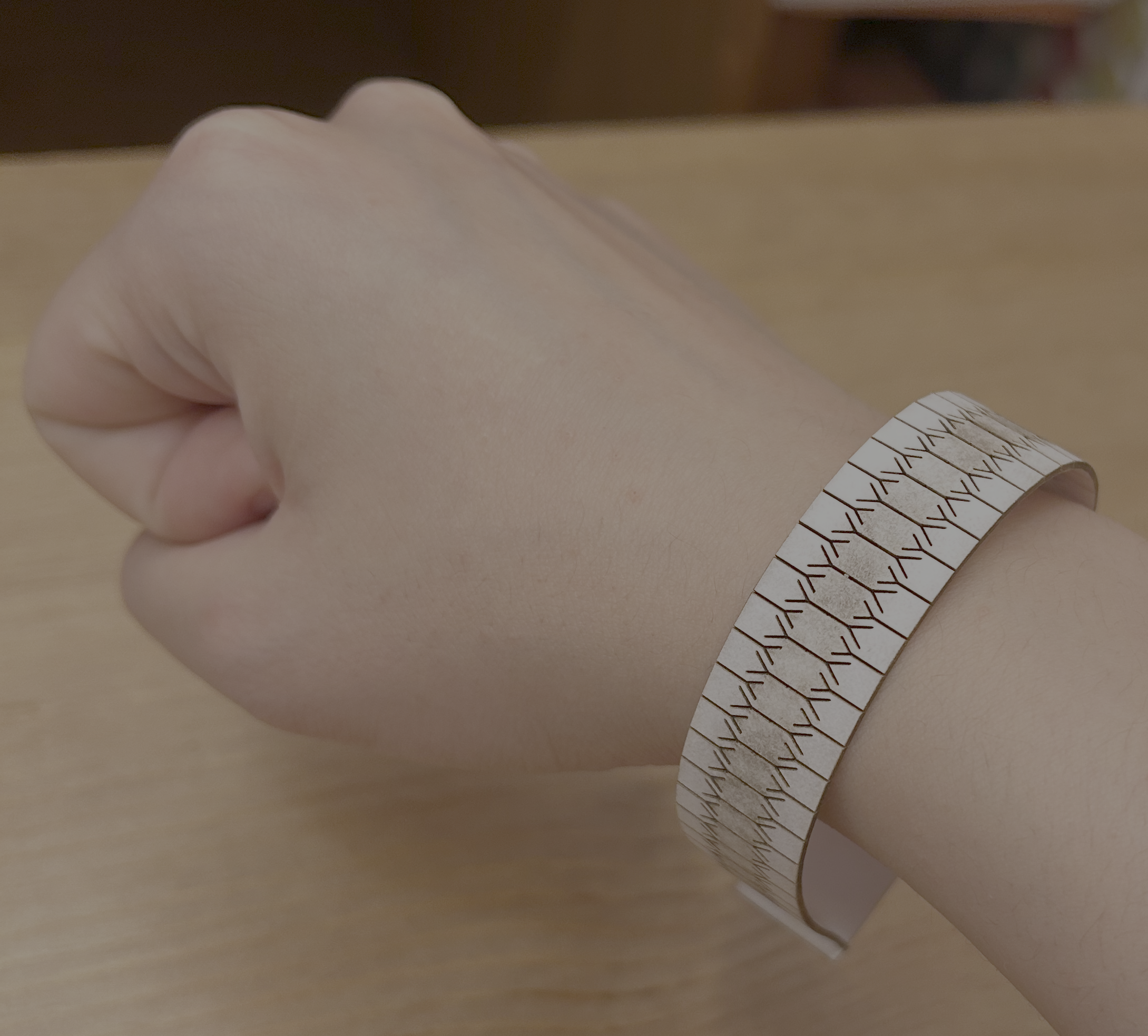
Final version: redesigned and dimensioned
Version 2 could bend, but its geometry wasn’t good enough for a final design. So I rebuilt the hinge around a different repeated Y-shaped cut pattern instead of just making the diamonds more even. I also changed my CAD workflow. I set the gap widths as explicit dimensions, used reference lines, and mirrored the pattern so both halves stayed symmetric. The new hinge cut more reliably and bent more predictably.


Failed attempts
Version 1: a curve that wouldn’t cut
I started with a complicated curved pattern. I built it by projecting and copying geometry back and forth in CAD, following suggestions from AI tools. I didn’t go to TA hours or ask classmates. The file couldn’t be cut.
Version 2: diamonds placed by eye
I switched to a simpler pattern of diamond-shaped slats and gaps. I copied and pasted the shapes and estimated the spacing without setting dimensions or constraints. This version could be cut and it could bend, so the basic idea worked. But the hand-spaced gaps were irregular, and the hinge looked uneven, bent inconsistently, and broke easily. The pattern also left small diamond cutouts that could fall out of the sheet during cutting and interfere with the machine.


What I learned.
Version 2 taught me that getting a living hinge to bend was only part of the problem. Its two failures had different causes. The uneven bending came from unconstrained geometry, so the fix was in my CAD workflow. The loose diamonds came from the pattern itself, so the pattern had to change. Asking classmates for feedback helped me find those issues sooner. The main lesson: when a cut fails, work out whether the problem comes from the geometry, the modeling process, or the fabrication step, and fix that part instead of patching the symptom.